
World Day Against Pain (October 20, 2025)
Reading time: 9 minutes
News

On October 20, 2025, World Pain Day, established by the International Association for the Study of Pain (IASP), powerfully reaffirmed an obvious truth: pain, whatever form it takes, is not inevitable. This annual event is a key moment to raise awareness among the general public, health professionals, and institutions about the importance of comprehensive, personalized care.
The stakes are enormous, for both public health and the economy. Chronic pain is now recognized as a disease in its own right, but the therapeutic response remains, in many cases, inadequate. Faced with the shortage of specialized facilities, modern digital tools such as the physiotherapy app Andrew® are emerging as powerful levers to bridge the gap and rehumanize the care pathway.
Chronic pain: the anatomy of an invisible ailment
Chronic pain differs from acute pain by its persistence: it lasts or recurs beyond three months. It is no longer a simple warning signal linked to an immediate lesion, but a complex pathological condition involving structural and functional changes in the central and peripheral nervous systems.
It is crucial to understand the multifactorial nature of pain, which is mainly classified into three types:
Nociceptive Pain: Linked to the activation of pain receptors (nociceptors) by tissue damage (e.g., osteoarthritis, sprain).
Neuropathic Pain: Caused by injury or disease of the nervous system (e.g., sciatica due to nerve compression, neuralgia).
Nociplastic Pain: Resulting from altered pain detection (nociception) without obvious tissue or nerve injury (e.g., fibromyalgia, certain chronic headaches, etc.).
Whatever its origin, the impact is massive in France. According to the French Society for the Study and Treatment of Pain (SFETD) and the Ministry of Health:
At least 12 million French people live with moderate to severe chronic pain, representing more than 20% of the population.
More broadly, the French National Authority for Health (HAS) indicates that nearly 20 million people are affected by chronic pain. These figures make pain the leading reason for consultation in general practice and emergency departments.
Beyond physical suffering, the ripple effect of chronic pain is psychological,
social and economic:
Psychological : 70% of patients suffering from moderate to severe chronic pain experience psychosocial consequences (sleep disorders, anxiety, depression).
Professional : 45% of patients are affected by work stoppages, with a cumulative average duration that can exceed 4 months per year.
Economic : The overall cost is estimated in billions of euros, including healthcare spending, but above all the loss of productivity linked to absenteeism and early disability.
The failure of the one-dimensional model and the urgency of the biopsychosocial (BPS) approach
One of the main obstacles to care lies in the persistence of a model that is often purely biomedical, seeking only to "repair the lesion" or mask the symptom with painkillers.
The challenge of the biopsychosocial (BPS) model
Yet research has validated the adoption of the Biopsychosocial (BPS) Model, which considers pain as a complex experience influenced by:
Biological Factors : The pathology, the lesion, bodily dysfunction.
Psychological Factors : Beliefs (fear of movement, kinesiophobia..), mood (anxiety, depression…), coping strategies.
Social Factors : Family support, the professional context, the socio-economic environment.
It is on these psychological and social factors that treatment must act to "deactivate" the pain signal. Yet the healthcare system struggles to apply this model: only 3% of chronic pain patients benefit from care in a specialized facility.
This is where digital technology comes in to provide the continuity and multidisciplinary approach that traditional facilities cannot guarantee at scale.
Andrew®: BPS expertise digitized for therapist and patient
Faced with this public health challenge and the need for BPS tools, the physiotherapy software Andrew® stands out as an essential partner. It digitizes comprehensive care, strengthening the therapeutic relationship and enabling patients to become active participants in their own relief.
Andrew® makes it possible to transform the subjective perception of pain into objective data, offering a real-time view of progress. Regular follow-up via simple questionnaires (such as the Visual Analog Scale - VAS) allows therapists to visualize symptom changes and adjust the care plan between appointments.
Our data collected on a sample of 478 patients confirm the rapid effectiveness of a structured approach integrating follow-up and content from Andrew®. The results show a significant improvement in perceived pain on the VAS scale (0-10) in just one week:
Statistics (scale VAS) | Pain at Day 0 (start of follow-up) | Pain at Day 7 | Change |
|---|---|---|---|
Mean | 4.76 | 3.21 | -1.55 points |
Median | 5 | 3 | -2 points |
Standard deviation | 2.05 | 2.34 | / |
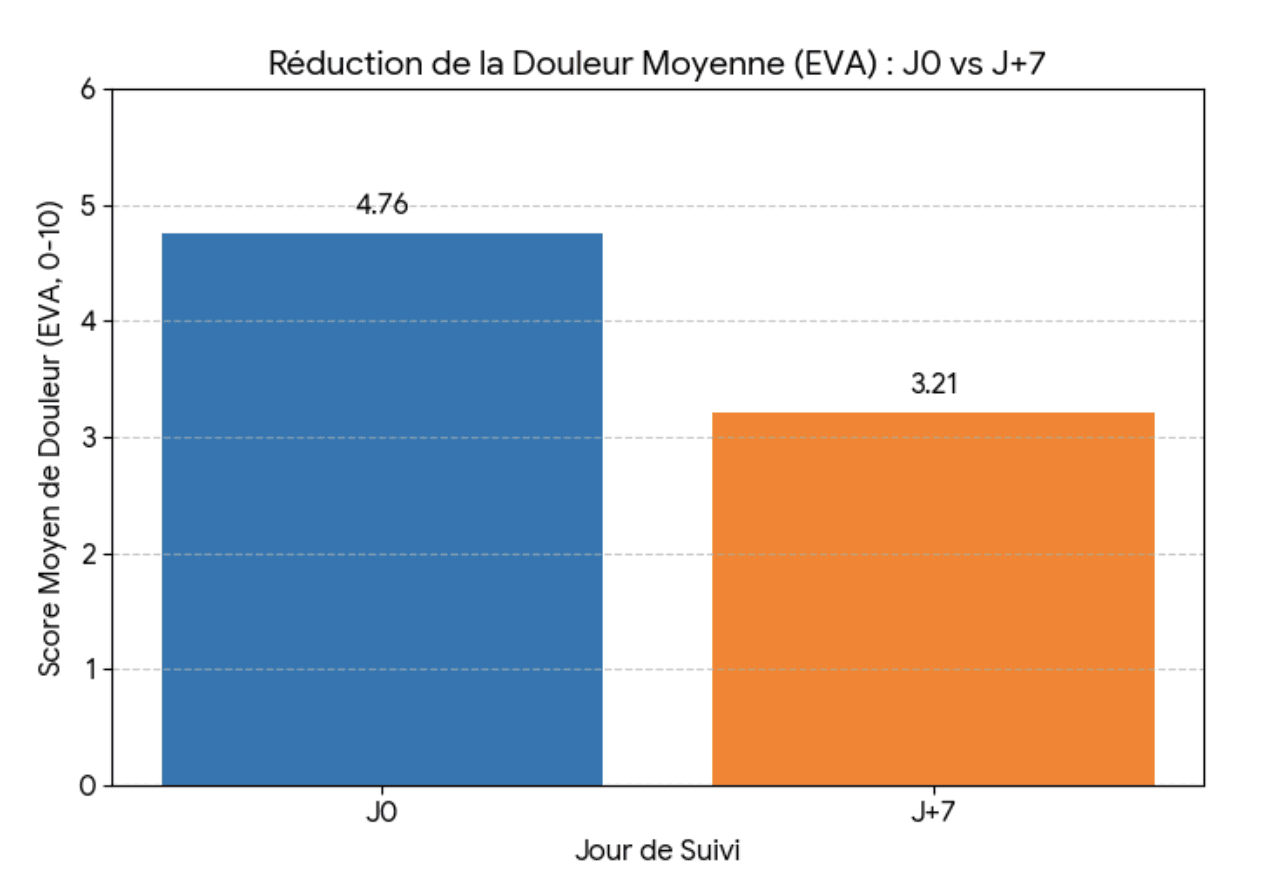
In this sample, we observe an average improvement of 1.55 pain points between day 0 and day 7. This rapid reduction in pain intensity, with the median dropping from 5 to 3, illustrates the positive impact of active care supported by digital tools. The dispersion of the data (standard deviation) remains controlled, which reflects effectiveness that is not limited to a few isolated cases. These concrete data reinforce the idea that structured, digital BPS care via Andrew® improves patient adherence and generates a significant reduction in pain intensity, notably through the regulation of psychosocial factors.
The app offers a complete toolkit that addresses the three pillars of the BPS model:
Biological Factor (Mobility and Function) :
Prescription of personalized exercises: Therapists can create and send tailored mobility and strengthening programs, selected from a library of thousands of videos. The patient receives a clear video guide to reproduce the movements at home.
Andrew® Coach : Enables block-based exercise prescription and precise tracking of progression to break the vicious cycle of sedentary behavior.
Psychological Factor (Mental and Cognitive) :
Managing anxiety: The physiotherapy software offers unlimited access to sophrology, meditation, hypnotherapy content, and a heart coherence module. These tools are essential to soothe the sensitized nervous system and reduce the emotional impact of pain.
Therapeutic education: Educational video and audio capsules are made available to help the patient understand their pain and dismantle false beliefs.
Social Factor (Therapeutic Relationship) :
Remote follow-up and communication: The platform maintains a constant link between the patient and the practitioner, which is crucial for motivation and treatment adherence. The therapist can adjust the program without waiting for the next in-person consultation.
The advantage of CBT and Andrew® expertise
For health professionals wishing to integrate expertise into their daily practice without being pain specialists, access to Cognitive Behavioral Therapies (CBT) via Andrew® is a major asset.
CBT and Pain: fighting kinesiophobia
CBT is the psychotherapy reference for chronic pain. They focus on changing the thoughts (cognitions) and actions (behaviors) that fuel the pain cycle.
The concept of kinesiophobia (fear of hurting oneself by moving) is central in chronic pain. This fear generates avoidance, stiffness and, paradoxically, increases pain and disability.
CBT aims to:
Identify these beliefs and fears.
Educate the patient about the neurophysiology of pain.
Offer gradual exposure to activity (gradual exposure).
Expertise within therapists' reach
The practitioner moves from being a simple exercise prescriber to a true health coach, capable of leveraging the psychological drivers of chronicity.
Anonymized use cases: proof by example with Andrew®
Two concrete examples illustrate how our physiotherapy software transforms the care of patients with chronic pain.
Case No. 1 : Marc, 45, and breaking the Anxiety-Pain cycle
Marc, a sales executive, suffers from chronic low back pain worsened by stress and anxiety. His pain was nociplastic in origin and highly fluctuating.
Issue: Fear of movement limited his physical progress, and work-related anxiety amplified his VAS score.
Solution: His osteopath prescribes gentle mobility exercises and emphasizes daily practice of heart coherence and micro-sessions of meditation available in the app (psychological pillar).
Results: The therapist observes a normalization of sleep on the follow-up platform and a decrease in VAS from 7/10 to 4/10 after 6 weeks. This result is attributed not only to mobilization, but above all to the regulation of the nervous system made possible by the mental wellness tools of the exercise prescription software.
Case No. 2 : Ms. Leroy, Physiotherapist, and physiotherapy exercise prescription
Ms. Leroy is a private-practice physiotherapist, aware of the need for a BPS approach for her patients suffering from chronic pain.
Issue: She lacks consultation time for therapeutic education and adherence checks.
Solution: She uses the physiotherapy app to pre-educate her patients. Before their first session, she sends them the CBT capsules and videos on the neurophysiology of pain.
Results: Patients arrive more cognitively equipped, making in-session work easier. Ms. Leroy uses the real-time symptom tracking feature to adjust her rehabilitation plan the day before the session. The physiotherapy software allows her to provide expert, personalized care without lengthening the duration of her consultations. She has positioned herself as a reference for chronic pain in her area.
Conclusion: the imperative of collective action
World Pain Day on October 20, 2025 reaffirms the urgency to act. The issue of the 12 to 20 million French people suffering from chronic pain will only be solved through the widespread adoption of modern, validated care models (BPS, CBT) made accessible to all.
The physiotherapy app Andrew® is not just a simple exercise prescription tool; it is a partner that enables health professionals to deliver comprehensive, continuous expertise, placing the patient at the center of their care journey. By digitizing the biopsychosocial approach, the physiotherapy app transforms support and gives hope back to millions of people.
Because recognizing pain means adopting cutting-edge tools to relieve it. If you are a health professional, find out how Andrew® can optimize the effectiveness of your care and strengthen your expertise today.
Article Sources