Monitoring adherence is one of the historic weak points of care: once the patient leaves the clinic, they forget, adapt, skip, abandon, and ten days later, when you ask them, “Have you done your exercises?”, the answer is invariably “Yes, well, more or less.” Andrew® changes the game. After each home session, the patient records precise feedback in their app: pain experienced, pain frequency, limited mobility, associated stress, RPE, exercises completed successfully or not, and pain localised to a specific exercise. The result: a genuine therapeutic decision-support report, with progress charts, which you can review before every consultation. For physiotherapists, osteopaths, podiatrists, chiropractors, midwives, sports doctors, psychologists, fitness coaches, adapted physical activity coaches and dietitians.



Live-shared patient experience
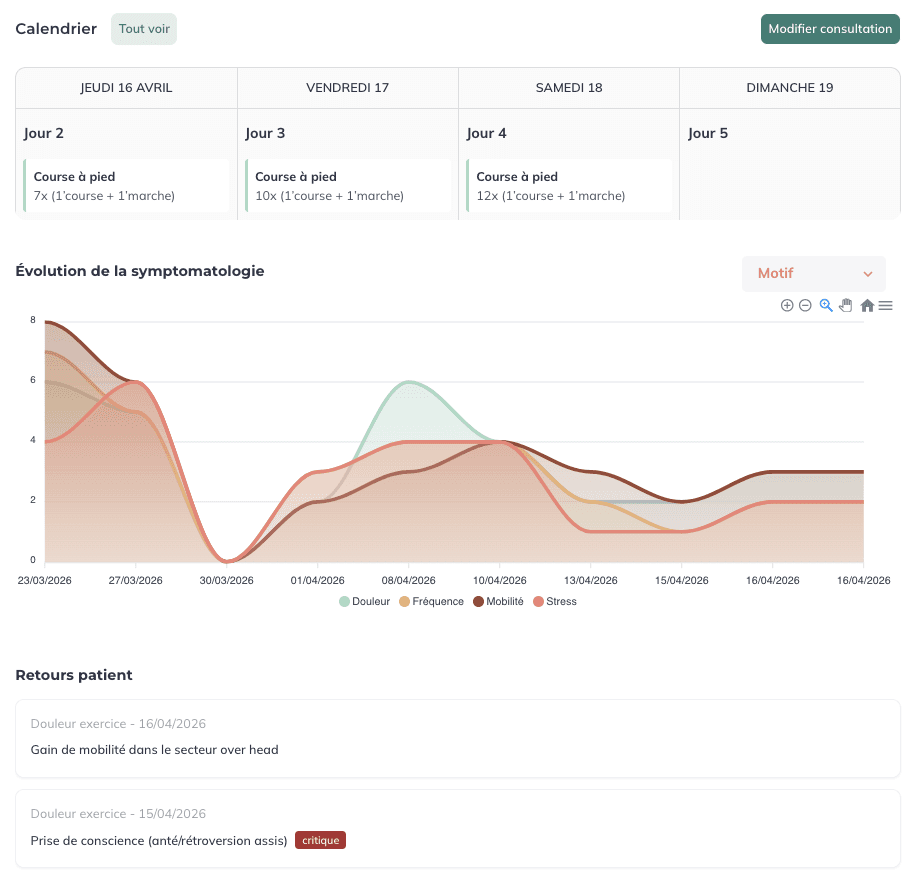
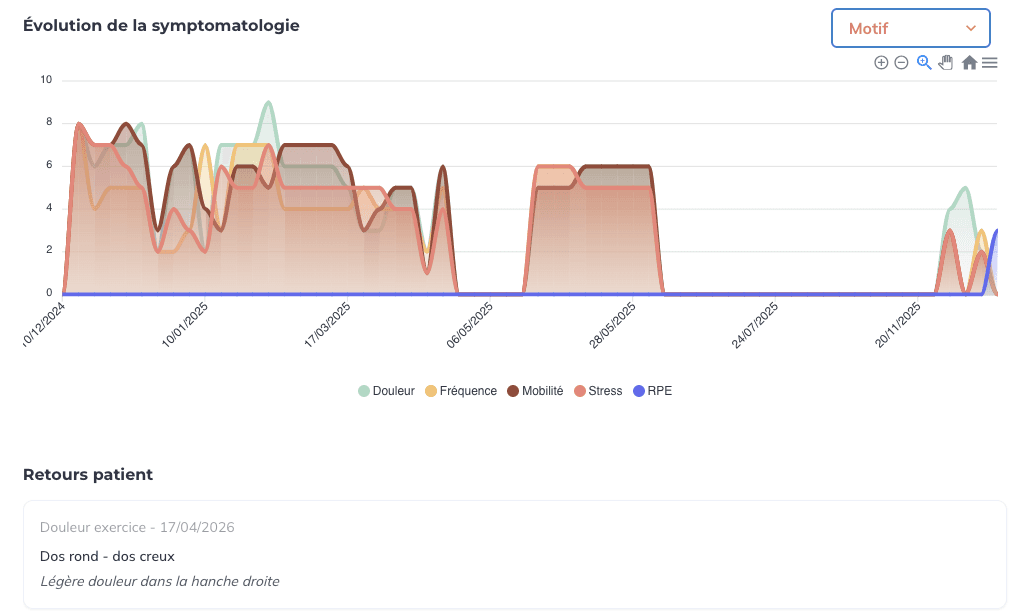
After each exercise session performed at home, the patient enters their feedback in a few seconds across five clinical dimensions: pain intensity (VAS 0-10), pain frequency throughout the day, perceived limited mobility, associated stress, and RPE (Rating of Perceived Exertion) for perceived effort. You no longer receive a simple « I'm fine »: you get a structured, time-stamped, longitudinal clinical signal, exactly the kind of data you have always wished you had.
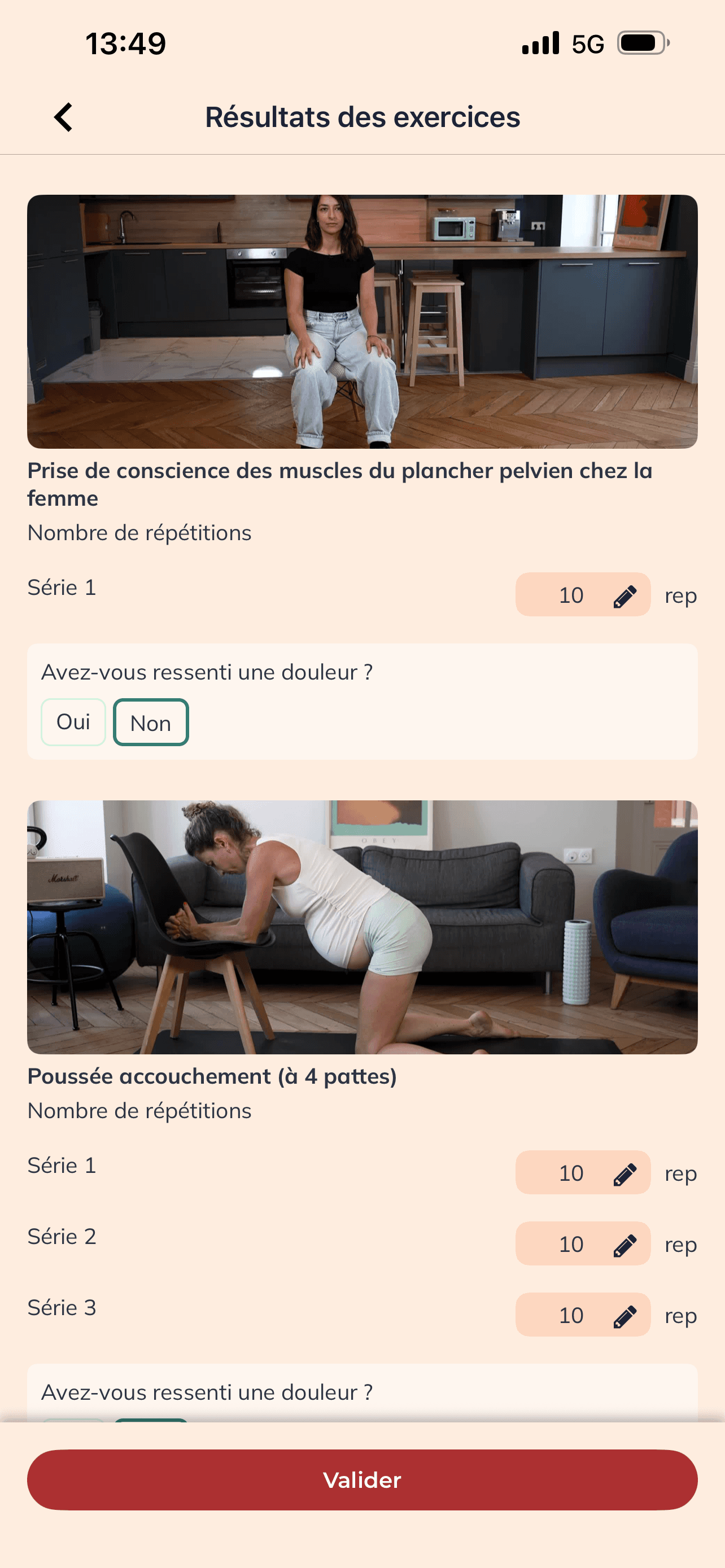
Precise feedback on each exercise completed, adapted, or skipped
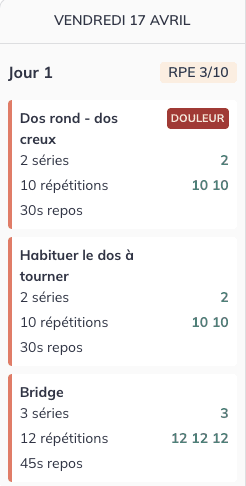
The patient details exactly what they actually did, exercise by exercise: all completed exercises, some modified (fewer repetitions, less load, reduced range of motion), others skipped (too painful, no time, no equipment). At a glance, you can see that they struggle with the single-leg squat, consistently modify the plank, or skip the evening stretches—practical information that immediately guides your next session.
Pain pinpointed to a specific exercise, no more rough estimation
If an exercise triggered a specific pain, the patient can report it on that exercise itself, at the moment they felt it, with its intensity and location. No more the classic “I had pain in something, but I don’t remember when or what” ten days after the session. You get the clinical signal in the right place, at the right time—essential for adjusting progression, identifying a provocation, or detecting a red flag that warrants a more thorough examination.
A therapeutic decision-support report with trend curves
All data entered by the patient feeds a longitudinal dashboard: pain trend chart, mobility chart, stress chart, weekly adherence rate, percentage of exercises completed versus modified versus skipped. Before each consultation, you open the report and see the trajectory over the last 10 days, not a reconstructed memory, not an estimate: data. Your clinical decision becomes faster, more precise, and better supported when discussing it with the patient.
Empower the patient without leaving them to fend for themselves.
One of the classic pitfalls of home-based prescribing is giving a program and then leaving the patient to it, a risky bet when adherence is one of the leading factors in treatment failure. Andrew® solves the paradox: the patient is autonomous in carrying out the program, but supported by the tool that records their feedback, and by you, who reviews that feedback. The therapeutic link is never broken between sessions, and the patient feels it.
A virtuous cycle: the tool is patient-centered, and the patient engages
A patient who knows that their clinician will review their feedback before the appointment naturally takes their exercises more seriously. They make an effort, they want to do well, and they honestly document their difficulties instead of hiding them. The tool is centered on them, they feel seen and supported, and the therapeutic alliance is strengthened as a result. This virtuous cycle is an effect found in the literature on digital health interventions, and in practical terms it translates into better adherence and improved clinical outcomes.
Andrew® finally provides a structured response: multi-dimensional patient feedback after each session, precise exercise-by-exercise feedback, pain pinpointed in the right place, and a longitudinal report with progress curves that becomes your real therapeutic decision-support tool.
You no longer work from memory. You work from data.
Frequently Asked Questions about Andrew® Adherence Monitoring and Therapeutic Adherence
What adherence data does Andrew® collect exactly after each at-home session?
After each home exercise session, the patient enters five clinical dimensions in a few seconds from the app: pain intensity on a 0-10 VAS scale, pain frequency over the day (occasional, intermittent, continuous), perceived restricted mobility, stress level associated with the session, and RPE (Rating of Perceived Exertion) for perceived effort.
He also indicates, exercise by exercise, which ones he completed in full, which ones he modified (and how: fewer repetitions, lower load, reduced range of motion), and which ones he skipped (with the reason: pain, fatigue, lack of equipment, lack of time). He can also pinpoint a specific pain that occurred during a specific exercise and briefly describe it. All of this data is time-stamped and aggregated in your longitudinal dashboard.
Why is adherence monitoring so difficult to obtain in the medical field in general?
How does the Andrew® compliance report help make better clinical decisions?
How does this follow-up help empower the patient without leaving them alone between appointments?
Which professions and which types of care benefit most from Andrew® adherence monitoring?

Hard to make a choice ?
Talk to your favorite AI assistant or book a demo with one of our therapists to learn more about Andrew® and discover how it can help your practice!






Video prescription of exercises and health education
Content created by the best French-speaking trainers
Teleconsultation, encrypted messaging, and billing
Customized program planning with Andrew® Coach
Patient-centered follow-up with hundreds of hours of sports, health, and wellness content
Contact us.