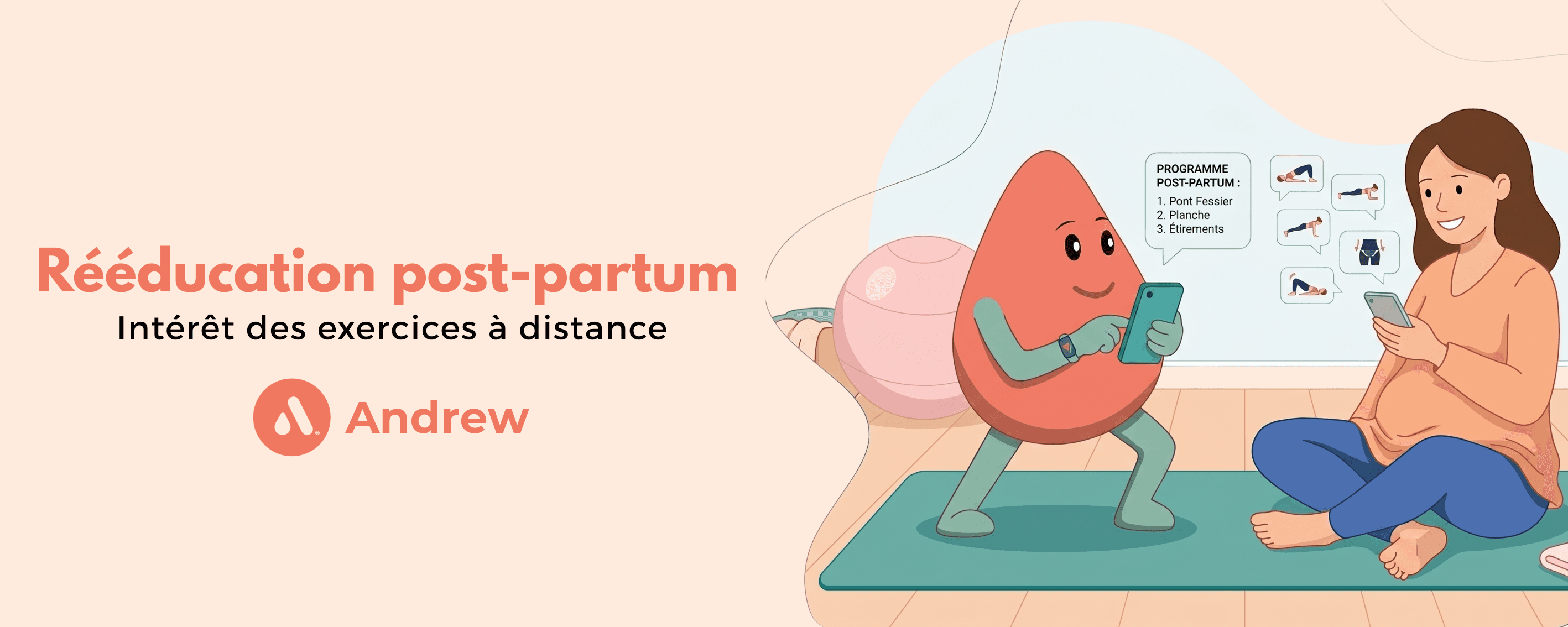
Physiotherapy software: prescribing postpartum rehabilitation exercises remotely
Reading time: 10 minutes
Guides

Approximately one in three women experiences pelvic floor dysfunction in the weeks following childbirth, whether stress urinary incontinence, pelvic heaviness, or diastasis recti. (1) However, postpartum follow-up often remains discontinuous: between the logistical constraints of young mothers, appointment delays, and poor compliance with prescribed home exercises, a vast amount of the clinical work done in-clinic does not yield long-term results.
The prescription of remote exercises, structured and supervised via dedicated physiotherapy software, fundamentally changes this equation. This article presents the clinical foundations, tailored postpartum protocols, and how digital tools tangibly transform the follow-up of these patients.
Why compliance is the real challenge of postpartum rehabilitation
Postpartum rehabilitation relies heavily on exercises performed between sessions: pelvic floor muscle training, hypopressive exercises, and progressive return to activity. Without patient adherence to these programs, clinical outcomes rapidly fade.
However, several factors specific to this period undermine compliance. The mental and physical burden of the postpartum period, exhaustion linked to caring for a newborn, breastfeeding, and reorganising daily life make performing exercises regularly difficult without external support. Paper exercise sheets or PDFs sent via email allow for neither real tracking nor program adjustments based on progression. (2)
A meta-analysis published in 2023 confirms that remote rehabilitation programs including mobile applications achieve equivalent results to conventional home programs, but with significantly higher adherence when clinical supervision is maintained. (2)
Postpartum exercise protocols that the physiotherapist can prescribe via software
Postpartum rehabilitative care covers several distinct clinical pathways, each requiring a protocol adapted to the recovery phase. To explore the clinical foundations before designing your programs, consult the comprehensive postpartum rehabilitation clinical guide.
Phase 1: Postpartum pelvic floor rehabilitation (Day 0 to Day 45)
The first weeks after childbirth are dedicated to pelvic floor awareness and reactivation. Exercises prescribed at this stage must be progressive, pain-free, and focused on proprioception:
Isometric pelvic floor contractions (guided Kegel exercises)
Transversus abdominis activation in the supine position
Diaphragmatic breathing exercises to integrate pelvic floor-diaphragm synergy
At this stage, guided video is particularly valuable: it allows the patient to replicate the movements correctly without interpreting a text description, which is often a source of execution errors. (1)
Phase 2: Hypopressive work and abdominal recovery (Day 45 to Month 3)
Once perineal healing is achieved and the pelvic floor is reactivated, work can shift toward abdominal wall recovery. In cases of diastasis recti, the protocol must strictly exclude any exercises involving high intra-abdominal pressure (crunches, classic sit-ups).
Here, physiotherapy software allows the creation of personalised programs that exclude certain categories of exercises, segmenting the library by clinical indication. The prescription is traceable, modifiable at each session, and accessible to the patient directly from their phone.
Phase 3: Returning to sport after childbirth (from Month 3)
Returning to sport after childbirth requires a rigorous functional assessment before cleared for high-impact activities. Validated clinical criteria include the absence of stress urinary incontinence, sufficient pelvic floor strength, and a diastasis of less than 2 cm under loading.
Remote prescription enables a gradual transition back to sport, week by week, with progressive rehabilitation exercises. Monitoring through integrated messaging or telehealth allows the physiotherapist to adjust the program without increasing the number of in-person consultations.
Patient autonomy as a therapeutic lever
The goal of postpartum rehabilitation goes beyond simply correcting dysfunctions: it involves supporting the patient toward long-term autonomy in managing their pelvic floor and their body after childbirth.
A 2020 randomised controlled trial showed that patients who followed their pelvic floor strengthening program via an app with audio guidance demonstrated better self-efficacy at 6 weeks, 3 months, and 6 months postpartum compared to the group using a conventional exercise sheet. (3) This self-efficacy is a robust predictor of recurrence prevention.
Patient autonomy is not achieved by replacing clinical follow-up with a digital program; it is achieved by structuring hybrid care where the physiotherapist remains the point of contact, but the patient has the tools to progress between sessions.
How physiotherapy software concretely structures this postpartum follow-up
Andrew® allows physiotherapists to set up this remote postpartum follow-up in a structured and clinically traceable manner. From the platform, the practitioner builds the patient's exercise program, selecting from a library of thousands of video contents, including exercises specific to the pelvic floor, hypopressive training, and postpartum return-to-sport rehabilitation.
Each patient receives their personalised program on their phone, can log completed sessions, and send feedback via secure messaging. The physiotherapist views the tracking dashboard, monitors actual compliance, and adjusts the program in a few clicks. If difficulties arise, a telehealth consultation can be launched directly from the platform.
For patients who cannot travel (new baby, geographical distance, early return to work), this system ensures continuity of clinical care without therapeutic interruption. Request a free demo to see how to configure a comprehensive postpartum program in a few minutes.
To explore compliance in other clinical contexts, our article on compliance and therapeutic exercises provides complementary insights.
Integrating remote prescription into your practice management
Integrating prescription software into postpartum clinical practice does not require overhaul of the clinic's entire structure. In the vast majority of cases, it fits into the existing care pathway as a hybrid model: assessment and manual therapy sessions are completed in-clinic, and inter-session exercises are prescribed and monitored remotely.
This model presents several advantages for private physiotherapists: it optimises in-session clinical time, reduces redundant check-up consultations, and maintains the therapeutic relationship with patients who might otherwise have abandoned their follow-up.
Setting up subscriptions for postpartum patients (monthly follow-up consultation and continuous access to their program) also represents an opportunity to develop structured, recurring out-of-pocket activities for physiotherapists specialising in pelvic health.
Conclusion
Remote postpartum rehabilitation is not a compromise compared to in-person care: it is a clinical lever in its own right, provided it is structured, traceable, and centred on patient autonomy. Literature evidence confirms that remote supervision, combined with appropriate digital tools, improves adherence and long-term functional clinical outcomes.
If you want to structure your postpartum clinical activity around dedicated physiotherapy software, the Andrew® team is available to chat. Speak with the Andrew® team to discover how to adapt the platform to your specialty.
Article Sources
Common questions and answers on this topic:
When can postpartum perineal rehabilitation begin?
Postpartum pelvic floor rehabilitation can begin as early as 6 to 8 weeks after an uncomplicated vaginal delivery. In the event of a complex perineal tear, this period may be extended. Light exercises (diaphragmatic breathing, pelvic floor awareness) are recommended from the very first weeks to prepare for formal rehabilitation work.
How many physiotherapy sessions are reimbursed after giving birth?
Is it possible to perform post-partum rehabilitation remotely?
Does returning to sport after giving birth require a physiotherapist's opinion?
What is a physio software for exercise prescription?
Is Andrew® suitable for post-partum pelvic floor rehabilitation?