Strength Training and Growth: What the Scientific Evidence Shows
Reading time: 7 minutes
Updated on
News

A misconception dispelled by the scientific literature: resistance training in young patients does not stunt growth. It is actually one of its greatest allies, provided it is properly supervised.
Strength training in adolescents faces persistent skepticism from the public, and occasionally from certain healthcare professionals. Yet, the evidence from recent literature reviews is unequivocal: muscular strengthening during puberty is not only safe, but it also serves as a prime therapeutic and preventive intervention. For the physiotherapist, understanding the underlying biological mechanisms is becoming an essential clinical competency.
At what age should strength training begin? Biological maturity over chronological age
Contemporary clinical consensus no longer sets an arbitrary minimum age. The relevant question is the child's neuromotor and emotional maturity, rather than chronological age. A child capable of understanding and following precise motor instructions can benefit from a structured strengthening program as early as 7 to 8 years of age.
Peak Height Velocity (PHV): a unique window of opportunity
Peak Height Velocity (PHV), typically occurring between ages 11 and 14 in girls and 13 and 16 in boys, marks a neuromotor window of exceptional clinical value. During this period, central nervous system plasticity peaks, and the skeletal response to mechanical loading is unmatched throughout the entire lifespan.
The challenge for the physical therapist is neither to miss this window nor to overload it without monitoring. This is precisely the role of structured, individualized follow-up.
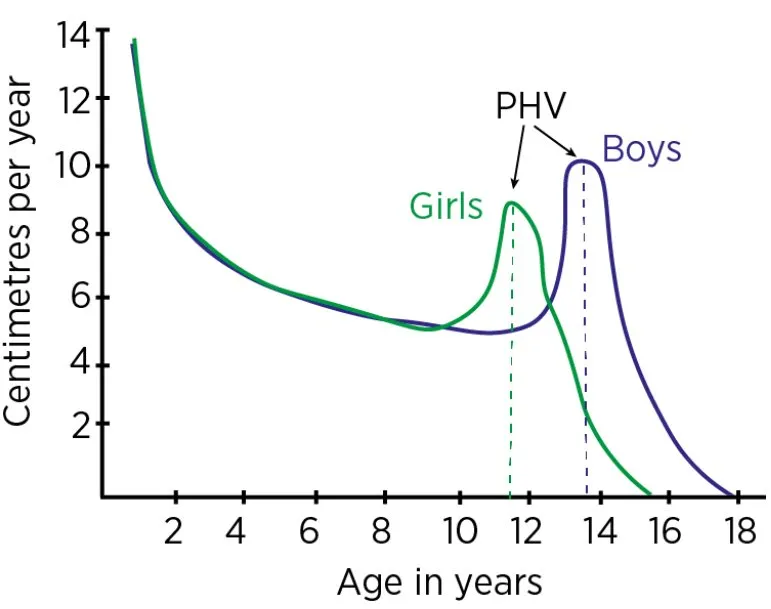
(Source: LondonBridge Sports Medicine Group)
Skeletal benefits: bone densification, Wolff's law, and prevention of apophysitis
Contrary to lingering concerns regarding growth plates (epiphyseal plates), controlled mechanical stress is physiologically the best osteogenic stimulus available during growth. This principle has been recognized since the 19th century as Wolff's Law: bone remodels in response to the forces placed upon it.
Optimizing Peak Bone Mass (PBM)
Puberty is when approximately 40% of an individual's total bone mineralization is accumulated. Mechanotransduction—the conversion of mechanical signals into cellular biological responses—is particularly efficient during this phase. Controlled studies demonstrate a significant increase in bone mineral density (BMD) in adolescents performing resistance training, exceeding that observed in adults trained under identical conditions.
Prevention of traction apophysitis
Osgood-Schlatter and Sever's disease are among the most common pathologies encountered in pediatric sports physiotherapy practice. These forms of apophysitis result from excessive traction on immature apophyses by insufficiently conditioned musculotendinous units.
A progressive eccentric and concentric strengthening program allows for improved distribution of tensile forces, yielding a clinically significant reduction in the incidence and recurrence of these conditions.
Osgood-Schlatter: progressive eccentric quadriceps strengthening
Sever's disease: triceps surae strengthening + proprioceptive training
Iliac apophysitis: lumbo-pelvic-hip core strengthening adapted to growth
Hormonal and molecular benefits: understanding the mTOR pathway
Puberty turns the body into a true anabolic engine. Surging levels of testosterone, GH, and IGF-1 create an exceptional endocrine environment. Resistance training does not disrupt this milieu; rather, it amplifies it via specific intracellular pathways.
Factor | Role and impact during puberty |
|---|---|
Testosterone | Increased androgen receptor sensitivity, promoting post-PHV hypertrophy. The adaptive response is significant even at modest circulating concentrations. |
Growth Hormone (GH) | Enhanced post-exercise pulsatile secretion, promoting tissue repair and linear growth. Exercise intensity directly modulates the secretory peak. |
mTOR Pathway | Master switch of protein synthesis. Resistance training activates mTOR via mechanotransduction, enabling gains in muscle cross-sectional area even with modest androgen levels. |
The mTOR pathway: the central molecular link
The mTOR (mammalian Target of Rapamycin) pathway is the primary intracellular regulator of muscle protein synthesis. This enzymatic complex responds directly to mechanical tension, translating the physical stimulus of resistance exercise into structural protein production (actin, myosin, titin).
The major clinical significance of the mTOR pathway is that it functions independently of circulating androgen levels. A pre-pubertal adolescent with minimal testosterone levels can therefore develop true functional hypertrophy via this pathway, provided the mechanical load is adequate and appropriately dosed.
Direct clinical implication: training load monitoring is not optional. It is the key lever to optimally stimulate the mTOR pathway without crossing into overreaching or overtraining.
The physical therapist's role: managing load to prevent overload
For the clinician, the therapeutic objective is clear: quantify mechanical stress to keep the patient within their optimal adaptation zone. The rapid growth variations during PHV, particularly the resulting strength asymmetries, necessitate rigorous, individualized, and documented monitoring.
Strength asymmetries: an underestimated clinical warning sign
During PHV, longitudinal bone growth outpaces musculotendinous adaptation. This results in inter-limb functional asymmetries that are often clinically silent but instrumentally measurable. These imbalances represent a documented risk factor for acute injury (strains, insertional tendinopathy) and chronic overuse (apophysitis, stress fractures).
Recommended assessment tools and monitoring strategies
Maximal isometric strength testing via handheld or stationary dynamometry
Agonist/antagonist ratio assessment (notably quadriceps/hamstrings)
Session training volume quantification (sets × reps × load)
Neuromuscular fatigue monitoring via RPE and countermovement jumps (CMJ)
Parental education grounded in objective data, essential for therapeutic adherence
Exercise prescription: structured for safety
Exercise prescription in adolescents must adhere to the same standards as any therapeutic prescription: dose, frequency, progression, and periodic reassessment.
Digital monitoring tools now allow physical therapists to structure this care pathway rigorously, maintain continuity between clinic sessions and independent home exercise, and reinforce therapeutic education for both the patient and their family. Solutions like Andrew®, dedicated to exercise prescription and patient-centered therapeutic education, help implement this tracking while optimizing available clinical time.
You can also read our article on optimizing clinical time through hybrid care, a compelling strategy to explore with these young patients.
Practical protocols: evidence-based recommendations
Evidence-Based Practice (EBP) in pediatric sports physiotherapy provides clear, reproducible, and objective guidelines. Clinicians now have a robust framework to structure patient management.
Recommended training parameters by age
Ages 7–11: Technique first. Light loads (60–70% estimated 1RM), 2–3 sessions/week, focus on coordination and core stability.
Ages 12–14 (pre-PHV): Progressive introduction of overload. 3 sets × 8–12 repetitions, complete recovery between sets.
Ages 14–17 (PHV and post-PHV): Structured resistance training. Periodization permitted, mandatory asymmetry monitoring.
Post-PHV: Adapted adult protocols; hypertrophy and power training safely accessible.
Precautions specific to the growth period
Several clinical precautions are unique to pediatric practice and fundamentally distinguish this population from adults:
Avoid excessive axial loading during rapid growth phases (no heavy squats or heavy overhead presses until technique is fully mastered)
Prohibit training to muscular failure in children and young adolescents
Prioritize recovery: connective tissues and cartilage adapt more slowly than the nervous system
Systematically involve parents in therapeutic education: understanding and adherence are documented determinants of clinical success
On the role of physical activity throughout rehabilitation, see also adherence: the missing pillar of rehabilitation.
Medico-legal and administrative aspects: key considerations
Managing pediatric patients in sports rehabilitation entails specific legal obligations regarding both informed consent and clinical documentation.
Consent and parental communication
In France, physical therapy care for a minor requires parental consent. When prescribing a program that includes muscular strengthening, best practice recommendations include:
Informing parents in writing of the program's objectives, methodology, and residual risks
Documenting parental consent in the patient's medical record
Sending a progress report to the referring physician at each major reassessment
Billing nomenclature and clinical coding
Rehabilitation sessions incorporating supervised muscle strengthening can be billed under the NGAP according to their clinical content. When utilizing digital platforms for remote prescription and tracking, teleconsultation (telehealth) opens reimbursable avenues for supplemental care while reinforcing adolescent patient autonomy between clinic visits.
Conclusion: strength training in puberty, a preventive medicine to prescribe
Strength training during puberty is neither a hazard to be mitigated nor a luxury reserved for elite athletics. It is a frontline therapeutic and preventive tool, supported by robust clinical evidence for:
bone mineral densification
mTOR pathway activation
prevention of traction apophysitis
correction of strength asymmetries.
The physical therapist is the ideal clinician to supervise this practice, bringing musculoskeletal expertise, mastery of functional assessments, an EBP culture, and the ability to educate families—provided care delivery is structured with tools suited to this clinical responsibility.
A physiotherapy software platform like Andrew® brings this workflow into clinical practice: personalized exercise prescription, progress tracking, therapeutic education for patients and their parents, and care continuity between clinic and home. Not to replace the clinician, but to amplify their clinical impact.
In pediatric sports physiotherapy, the best prevention against growth-related injuries is an appropriately prescribed, carefully monitored dose of muscle strengthening.
Article Sources
Your questions
Your questions, answered

No. Recent literature reviews show that properly supervised resistance training does not inhibit growth. During puberty, controlled mechanical loading actually stimulates bone mineralization (Wolff's law).
There is no longer a fixed minimum age: what matters is neuromotor maturity. A child capable of following precise movement cues can participate in a structured strengthening program from as early as age 7 to 8, prioritizing proper technique and light loads.
Not when the load is dosed and the technique mastered. Precautions: no heavy axial loads during growth spurts, no training to failure in children, and adequate recovery, as cartilage adapts more slowly than the nervous system.
Ages 7 to 11: light loads (60 to 70% of estimated maximum), 2 to 3 sessions per week, coordination and core strengthening. Ages 12 to 14: 3 sets of 8 to 12 repetitions. Ages 14 to 17: structured strength training, with monitoring for asymmetries.
It reduces the risk. Progressive eccentric and concentric strengthening better distributes traction forces across the bony tuberosities. For Osgood-Schlatter disease, eccentric quadriceps strengthening is targeted; for Sever's disease, the triceps surae is targeted along with proprioceptive work.
Yes. The care and management of a minor requires parental consent. It is recommended to inform the parents in writing about the program's objectives and risks, document their consent in the medical record, and send a progress report to the referring physician at each reassessment.
Are you still not listed among Andrew® therapists?
- Video prescription of exercises and health education
- Content created by the best French trainers
- Teleconsultation and billing
- Customized program planning with Andrew® Coach
- Patient-centered follow-up with hundreds of hours of sports, health, and wellness content