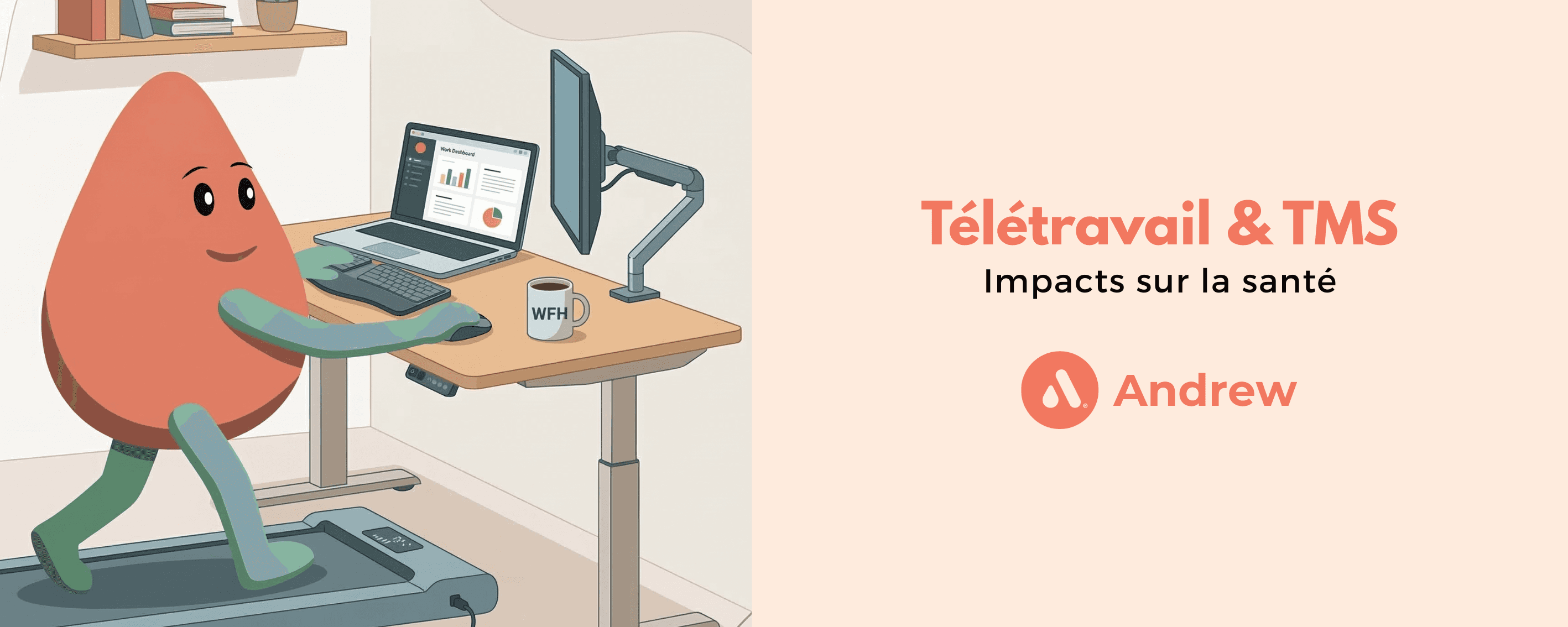
Remote work and musculoskeletal disorders: how does your home office affect your health (and how can you protect yourself)?
Reading time: 12 min
Guides
Andrew®

Introduction: when the couch replaces the desk... and your back pays for it
Remote work has become part of the daily lives of millions of French workers since 2020. According to DARES, nearly 3 out of 10 employees now work remotely at least one day a week. While this arrangement offers flexibility and time savings, it hides a less flattering reality: the explosion of musculoskeletal disorders (MSDs) linked to sedentary work at home.
At home, the workstation is often improvised: a kitchen chair that is too low, a laptop placed on a coffee table, or worse, several hours spent on a couch. These situations create repeated postural strain that, over time, leads to pain and pathology.
Physical therapists see every week in consultation the direct impact of poorly designed remote work on patients' health. Neck pain, low back pain, shoulder tension, carpal tunnel syndrome: MSDs linked to remote work now account for a growing share of physical therapists' clinical activity.
In this article, we will review the most common pain experienced by remote workers, identify its causes, and above all give you practical and scientifically validated solutions to turn your home office into a true ally for your health. We will also take the opportunity to see how remote work allows physical therapists to develop their non-covered activity.
Remote work and MSDs: a scientifically established link
What is a musculoskeletal disorder (MSD)?
Musculoskeletal disorders include all painful conditions affecting muscles, tendons, nerves, and joints, often in the upper limbs, neck, and back. They develop gradually under the effect of repeated or prolonged mechanical stress.
The most common MSDs among remote workers include:
Low back pain: pain in the lower back, the leading cause of disability worldwide
Neck pain: cervical pain linked to the position of the head in front of a screen that remains still for long periods
Carpal tunnel syndrome: compression of the median nerve at the wrist
Shoulder tendinopathies: inflammation of the rotator cuff
Lateral epicondylalgia: elbow pain, also known as "tennis elbow"
Key figures: what the studies say
Recent scientific data confirm the impact of sedentary work on the musculoskeletal system. A systematic review published in Human Factors covering 12 studies showed that interventions aimed at reducing sitting time result in an average reduction in sedentary behavior of 68.7 minutes per day at 3 months and 77.7 minutes per day at 6 months.
A randomized controlled trial evaluating a 6-month intervention with a sit-stand desk showed a significant reduction in overall musculoskeletal discomfort (p = 0.018) and post-work fatigue (p = 0.013) in office workers. Simply adding 30 minutes of standing per day is enough to produce measurable benefits.
Why does your home office hurt you?
Prolonged static posture: enemy number one
Contrary to what is often believed, the problem is not so much the bad posture itself as the prolonged static holding of any posture. Muscles and ligaments are not designed to remain motionless: they need movement to be nourished and oxygenated.
Screen too low (laptop): excessive neck flexion, tension in the trapezius and levator scapulae muscles
Unsuitable chair: lack of lumbar support, hips held in forced flexion, compression of the ischial tuberosities
No footrest: pelvic tilt backward, increased lumbar kyphosis
Mouse and keyboard poorly positioned: prolonged strain in shoulder rotation and abduction
Sedentary behavior: beyond local pain
Prolonged sitting leads to increased lumbar disc pressure, reduced activity of the deep stabilizers (transversus abdominis, multifidus), and progressive shortening of the hip flexors (psoas, iliacus). A meta-analysis published in BMC Public Health showed that using a walking pad increases energy expenditure by more than 105 kcal per hour compared with sitting.
The most common pains among remote workers
Low back pain: the scourge of the century amplified by remote work
Low back pain affects 80% of French people at some point in their lives. In remote work, the risk is greatly increased. A randomized trial (Brakenridge et al., 2026) showed that alternating 30 minutes sitting / 15 minutes standing reduces maximum low back pain by −1.33/10 and average pain by −0.83/10 in just 3 months.
Neck pain and tension headaches
With a laptop, the head is in flexion of 30 to 45° on average, which multiplies the apparent weight of the head on the cervical vertebrae by 3 to 5. Neck pain is often accompanied by tension headaches, postural dizziness, and a feeling of heaviness in the upper limbs.
Shoulder tension and upper-limb syndromes
Prolonged use of a mouse without forearm support leads to continuous activation of the shoulder muscles. Over time, this promotes the development of rotator cuff tendinopathies and carpal tunnel syndromes.
Validated ergonomic solutions: move more, move better, every day
The height-adjustable desk: the most documented solution
The height-adjustable desk (sit-stand desk) is currently the best-documented solution for preventing MSDs linked to remote work (Silva et al., 2025, effects maintained at 3, 6, and 12 months).
Sitting height: elbows at 90°, shoulders relaxed, feet flat
Standing height: elbows at 90°, screen at eye level
Recommended ratio: 30 minutes sitting / 15 minutes standing
Alarm or app: reminders every 30 minutes
Changing position by itself is enough to activate the stabilizing muscles and reduce lumbar disc pressure.
The walking pad: more than a trend, a therapy
The walking pad (treadmill desk) is a natural evolution of the active desk. Walking at a slow speed (1.5 to 3 km/h) does not affect cognitive performance or productivity. Physical therapists recommend introducing this habit gradually: 20 to 30 minutes per day at the start of practice.
Active micro-breaks: simple and effective
Even without investing in equipment, adding active micro-breaks every 45 to 60 minutes is a highly effective preventive measure:
Cervical retraction: chin back, 10 repetitions
Shoulder rolls: 10 rotations backward
Standing lumbar extension: hands on the back, gentle extension
5-minute walk: reactivates circulation and postural muscles
Hip flexor stretches: low lunge, 30 seconds per side
The role of the physical therapist in preventing and treating MSDs from remote work
When should you consult a physical therapist?
Too many patients wait until the pain becomes disabling before seeking care. In physical therapy, the earlier the management, the more effective it is. It is recommended to make an appointment without delay if you have pain lasting more than 2 weeks, pain radiating into the limbs, numbness, prolonged morning stiffness, or discomfort affecting sleep and productivity.
Physical therapy management of MSDs related to remote work
Physical therapy is recognized as a first-line treatment for MSDs, covered by French Health Insurance with a medical prescription. Management generally includes: postural assessment, manual therapy, active rehabilitation, patient education, and ergonomic advice for the remote workstation.
Non-covered services: additional offerings to go further
Beyond conventional reimbursed sessions, certain services outside the physical therapy fee schedule make it possible to offer more comprehensive support: workstation ergonomics consultations, workplace prevention programs, and personalized exercise prescriptions.
To go further, our guide on how to develop a profitable non-covered physical therapy activity will give you all the keys to structuring this offering in your practice.
Exercise prescription and teleconsultation: modern tools in the service of the patient
Exercise prescription: a treatment in its own right
The prescription of exercises is recognized as a full therapeutic approach in the management of MSDs. A well-designed program targets: spinal muscle strengthening, stretching of the hip flexors and pectoral muscles, proprioceptive work, and load progression management.
Adherence to the program is the key success factor. Also discover our article on adherence and outcomes in rehabilitation to better understand how to maximize your patients' engagement.
Digital tools for prescribing: the example of Andrew®
The practical implementation of exercise prescription is facilitated by specialized physical therapy prescription software such as Andrew®. This tool allows the physical therapist to create, in just a few minutes, a personalized program of illustrated exercises that the patient receives directly on their phone.
Andrew® offers in particular a library of validated exercises, adherence tracking, an educational module for patient education, and integrated teleconsultation. For the remote worker, the prescribed exercises become therapeutic active micro-breaks built into the day.
Teleconsultation in physical therapy: possible and relevant
The teleconsultation in physical therapy offers a relevant solution for remote workers who struggle to travel or want follow-up between in-person sessions. In France, it remains mostly a little-adopted service. To learn everything about remote follow-up in physical therapy, consult our complete guide dedicated to this rapidly growing practice.
Practical action plan: 10 golden rules for the healthy remote worker
Set up your workstation: screen at eye level, back supported, elbows at 90°
Follow the 30/15 rule: 30 minutes sitting, 15 minutes standing or moving
Set alarms: reminders every 45 minutes to stand up and move
Use a sit-stand desk: worthwhile investment within 3 months according to studies
Consider a walking pad: even 30 minutes a day changes your sedentary profile
Hydrate regularly: dehydration worsens muscle pain
Do your prescribed exercises: even 10 minutes a day is enough
Vary your activities: standing calls, short tasks interspersed with breaks
Take care of your sleep: nighttime rest is the main factor in muscle recovery
Seek care early: do not wait until the pain becomes established before consulting your physical therapist
These recommendations are general. Your physical therapist will adapt them to your personal situation.
Conclusion: your desk can become your ally again
Remote work is not doomed to mean pain and discomfort. With the right setup, the right habits, and appropriate physical therapy support, your home workstation can become a real asset for your health.
The science is clear: moving regularly, even briefly, radically changes the impact of sedentary behavior on your body. Exercise prescription software such as Andrew® makes it possible to extend the therapeutic benefit of sessions into your daily life as a remote worker, directly from home.
Do not wait for pain to set in before acting. Make an appointment with your physical therapist at the first signs of discomfort. Prevention is always simpler, and less costly, than treating an established MSD.
Article Sources
Common questions and answers on this topic:
Can telework really cause musculoskeletal disorders (MSDs)?
Yes. Remote work is associated with a significant increase in musculoskeletal disorders (MSDs), particularly low back pain, neck pain, and carpal tunnel syndrome. The main contributing factor is prolonged static posture in an inadequately adapted environment: an unsuitable chair, a screen positioned too low, and a lack of lumbar support. Recent scientific studies confirm that reducing sitting time by 60 to 80 minutes per day is enough to produce measurable benefits in musculoskeletal discomfort and post-work fatigue.
What is the best solution to avoid pain while teleworking?
Can prevention of musculoskeletal disorders be done outside the fee schedule?
Is the walking pad really effective against sedentary behavior while working from home?
What is an exercise prescription software like Andrew® used for in telework-related musculoskeletal disorders?
Is physiotherapy teleconsultation reimbursed in France ?