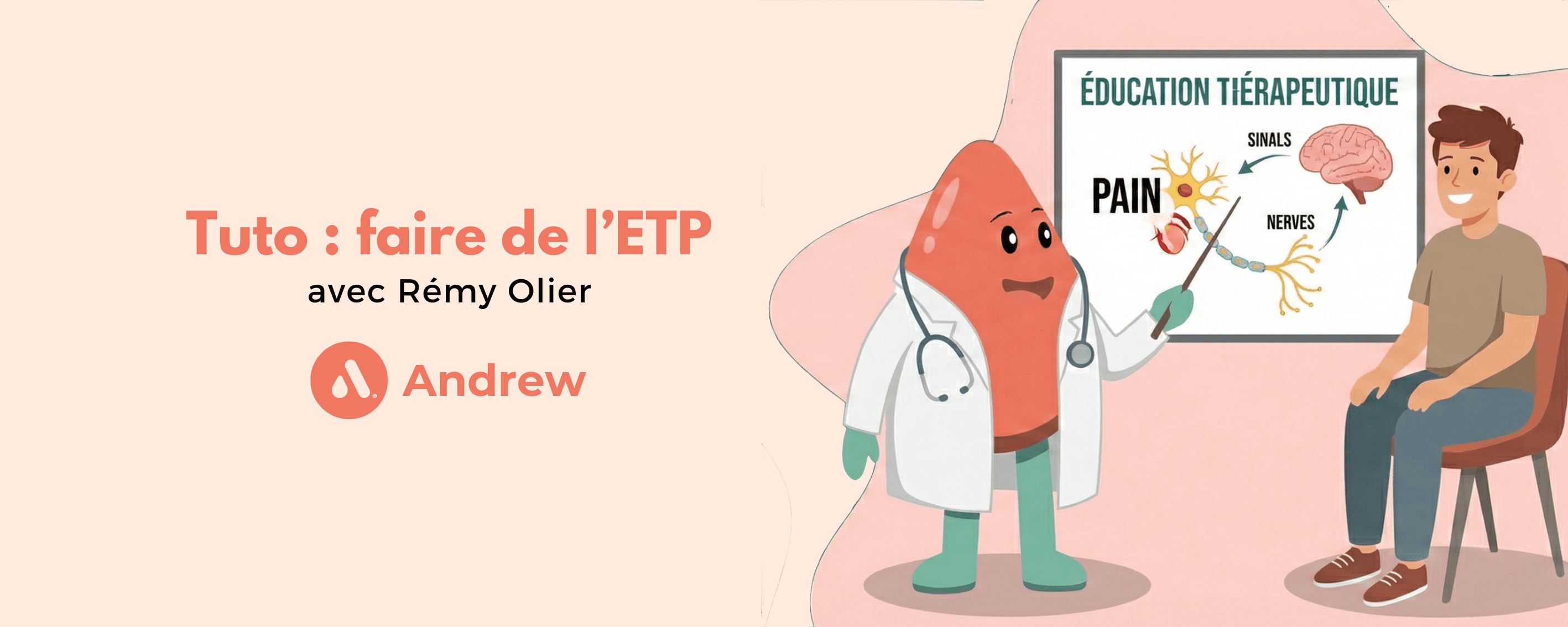
How to provide therapeutic patient education (TPE) for chronic pain? Top essentials
Reading time: 12 minutes
Guides
Webinars

Introduction
Therapeutic patient education (TPE) in chronic pain is now an essential cornerstone of modern physiotherapy management. Yet, according to Rémy Olier, a physiotherapist and recognised trainer in the field of persistent pain, the majority of practitioners make a fundamental mistake: they teach instead of helping patients discover.
Through a critical analysis of his own practice, filmed and dissected, Rémy Olier reveals the pitfalls of old-school pain education and proposes an approach centred on genuine patient empowerment.
This article decodes the key principles of this active pedagogy, rooted in pain neuroscience and cognitive psychology, and shows how to radically transform your therapeutic education practice to achieve lasting clinical results. And how physiotherapy software can help achieve those results.
Entrez vos coordonnées pour accéder à la rediffusion
The trap of lecture-style teaching: when the therapist talks too much
The classic scene of failed education
Rémy Olier opens his demonstration with an intentionally clumsy role-play, reproducing what he calls old-school pain education. The physiotherapist asks his patient about the factors that modulate their pain. The patient mentions lack of sleep as an aggravating factor and social interactions as a relieving factor. So far, everything seems to be going well.
But here is where the trap closes. Instead of continuing to question the patient so they can discover the underlying mechanisms for themselves, Rémy Olier abruptly switches to theoretical teaching:
"Pain is an alarm. An alarm that does not necessarily go off when there is a real danger, but when there is a potential danger".
He continues with the alarm metaphor, explaining that lack of sleep is perceived as a threat by the nervous system.
Result? The patient switches off. They have not discovered anything; they have simply sat through a lecture.
Why this approach fails every time
Rémy Olier identifies three fatal errors:
The premature theoretical dump: Imposing abstract concepts ("pain as an alarm") without allowing the patient to work through that understanding intellectually. The practitioner arrives with "something to bring", a preconceived notion they must deliver at all costs.
The absence of Socratic questioning: Rather than asking questions that prompt reflection ("Do other contexts influence your pain? The last time you were in a lot of pain, what happened?"), the therapist simply notes passively what the patient says, then switches to their theoretical content.
The loss of the sense of discovery: "You have not discovered anything for yourself" Rémy Olier stresses. The patient leaves without having done any personal cognitive work. They have only received information, exactly as they could by reading an online article.
This top-down approach generates what the educational sciences call superficial learning: the patient may be able to repeat the alarm metaphor the following week, but it has produced no behavioural change. "We see them again, ask what it changed: nothing"
The revolution in questioning: helping patients discover rather than teaching
The Socratic principle applied to pain
The alternative proposed by Rémy Olier draws directly on Socratic maieutics: drawing out the patient's own understanding. Instead of saying "Here is what pain is", the therapist asks "In your view, why does lack of sleep increase your pain?"
This radical transformation is based on a principle from the cognitive sciences: the generation of hypotheses by the patient themselves creates deeper and more durable neural connections than simply receiving information. This is called the generation effect in cognitive psychology.
Open questions vs questions that make people think
Rémy Olier qualifies a widespread dogma:
"We always say to ask open questions. I am wary of open questions because sometimes, if you ask too many open questions, you get caught out".
The issue is not so much the format of the question (open vs closed) as its ability to trigger reflection.
Examples of questions that make people think in pain education:
"Are there other contexts where your pain changes in intensity?" (exploring modulating factors)
"The last time you were in a lot of pain, what had happened just before?" (contextual analysis)
"In your view, why do social interactions reduce your pain?" (hypothesis generation)
"What do these different contexts have in common?" (abstraction and conceptualisation)
These questions progressively build cognitive scaffolding. The patient does not receive the ready-made answer ("pain is an alarm"); they build it themselves from their own lived experiences.
The trap of premature theory
The mistake identified by Rémy Olier is clear: "Rather than continuing with 'is there anything else?', I went straight to 'OK, would you like to know in theory what pain is?'". This abrupt turn towards theory betrays a need of the therapist ("I have something to bring you"), not a need of the patient.
In modern therapeutic education, theoretical content (pain neuroscience, the biopsychosocial model) should only be introduced when the patient has identified a pattern that requires explanation. That is when the alarm metaphor makes perfect sense, because it answers a question the patient has asked themselves.
Changing behaviour in response to pain: the ultimate goal
Beyond knowledge: aiming for behavioural change
Rémy Olier asks the key question: "How do we actually manage to change a patient's behaviour in response to their pain?" It is not by getting them to repeat "pain is an alarm" that their life habits will change.
The transtheoretical model of change (Prochaska and DiClemente) teaches us that behavioural change requires several stages: awareness, intention, preparation, action and maintenance. Pain education usually covers only the first stage (awareness), without supporting the patient through to concrete action.
The patient's experience: an indicator of success
When Rémy Olier asks the patient what they felt, the response is clear:
"The fact that it takes me to reflect on something I hadn't reflected on, and that I don't particularly want to reflect on in relation to this concept of pain, does not really speak to me about thinking about a concept".
This blunt but honest response reveals a fundamental mismatch between what the therapist wants to convey (a conceptual model of pain) and what the patient is looking for: "I want to be helped, I want to find solutions, I want to have practical things as well".
This gap between abstract theory and concrete solutions explains why so many patients drop out of pain education or derive no measurable clinical benefit from it. The patient does not want to become an expert in pain neurophysiology; they want to suffer less and live better.
From concept to action: the missing link
Truly effective therapeutic education must create a bridge between understanding and action. For example:
Step 1 - Guided discovery: The patient identifies that their sleep influences their pain
Step 2 - Hypotheses: "According to you, why does lack of sleep increase your pain?"
Step 3 - Targeted theoretical input: Only now, introduction of the concept of harmful hypervigilance and central sensitisation
Step 4 - Action plan: "What could you put in place this week to improve your sleep?"
Step 5 - Anticipating obstacles: "What might stop you from doing it? How could you work around that obstacle?"
This methodical progression turns intellectual understanding into a concrete action strategy, which alone allows lasting behavioural change.
Patient engagement: the engine of retention
The phantom consultation syndrome
Rémy Olier describes the classic failure scenario: "We see them the following week, ask what changed, and nothing. And then sometimes, when we ask them to repeat it as well, nothing has come out of it". This phenomenon, which we will call phantom consultation syndrome, reveals entirely superficial learning.
The neurosciences of learning show that information retention requires deep encoding, which is impossible to achieve through passive listening alone. According to the levels of processing model (Craik & Lockhart, 1972), the deeper the processing of information (involving reflection, connection with personal experiences, generation of hypotheses), the more durable the memory trace.
Helping patients discover vs helping them memorise
"You have not discovered anything for yourself", Rémy Olier concludes. This sentence sums up the failure of the lecture-style approach. The patient has been a spectator of their own education instead of its main actor.
Comparison of the two approaches:
Lecture-style approach (ineffective):
The therapist brings pre-established theoretical content
The patient listens passively
Low retention (forgotten within 7 days)
No observable behavioural change
Socratic approach (effective):
The patient explores their own experiences with guidance
The patient generates their own explanatory hypotheses
Strong retention (lasting integration)
Spontaneous and maintained behavioural change
This radical distinction rests on the principle of cognitive ownership: we only truly possess what we have built ourselves.
Practical methodology: implementing Socratic education in clinic
Step 1: in-depth contextual exploration
Before any educational intervention, devote at least 15 to 20 minutes to exploring the patient's pain-modulating factors. Rather than passively noting what the patient says, dig into each lead.
Key questions for this phase:
"Tell me about a recent time when your pain was particularly intense. What was happening that day?"
"Now think of a time when your pain was manageable. What was different?"
"Are there activities or situations in which you almost forget your pain?"
"How does your sleep influence your pain? Have you noticed any patterns?"
"Are your mood and your pain connected? How?"
The aim: gather as many concrete examples as possible before introducing any theoretical concept. This is the raw material that will then allow guided discovery.
Step 2: facilitating the emergence of patterns
Once the situations have been collected, help the patient identify the common patterns. This is where the art of questioning comes into its own.
Example of a Socratic progression:
Therapist: "You told me that your pain is worse when you have not slept well, and also when you are stressed at work. What do those two situations have in common, in your view?"
Patient: "I don't know... I'm more tired?"
Therapist: "Yes, and when you are tired or stressed, how does your body react overall?"
Patient: "I'm more tense, more on edge..."
Therapist: "Exactly. And conversely, you told me that seeing your friends reduces your pain. How do you feel in those moments?"
Patient: "Relaxed, happy... I think about something else."
Therapist: "So, if I summarise what you have just discovered: your pain seems to increase when your nervous system is on alert, and decrease when it is calm. What do you think?"
It is the patient themselves who has just conceptualised the link between their nervous system state and their pain. The therapist has merely guided the emergence of this understanding. Only now can the alarm metaphor be introduced, and it will resonate deeply because it validates an intuition the patient has formulated themselves.
Step 3: targeted theoretical input and validation
Only after this co-construction can the neurophysiological model be introduced, but in a brief way and in echo with the patient's discoveries:
"What you have just discovered corresponds exactly to what pain neuroscience teaches us. Pain works like an alarm system. This alarm does not only go off when there is a real danger to your tissues, but whenever your brain perceives a potential threat. When you lack sleep or are stressed, your brain considers you more vulnerable, so it makes the alarm more sensitive. Conversely, when you are relaxed with your friends, your brain judges the context to be safe, so the alarm is less sensitive. It is your own experience that has just taught you this."
This formulation turns theoretical content into scientific validation of the patient's intuition, rather than information imposed from outside. The difference is radical in terms of engagement and retention.
Step 4: from concept to concrete action
Rémy Olier reminds us that the patient is looking for "practical things". The final phase of education must therefore inevitably lead to a personalised action plan.
Questions for this phase:
"Now that you understand how your alarm system works, what could you put in place this week to calm it down?"
"Among the factors you have identified, which one seems easiest to change first?"
"Practically, when and how are you going to do that?" (implementation planning)
"What might stop you from doing it? How could you anticipate that obstacle?"
This phase turns understanding into concrete behavioural commitment, the only guarantee of lasting change. This is also the point at which tools such as Andrew® can make perfect sense.
Integrating digital tools into Socratic education
Andrew®'s role in educational continuity
Rémy Olier's approach, based on guided discovery and behaviour change, finds a natural extension in tools such as Andrew®. This physiotherapy software for exercise prescription and therapeutic education makes it possible to extend the work initiated in the clinic.
How Andrew® complements this education:
Immediate personalisation: Once the modulating factors have been identified (sleep, stress, social activity), Andrew® makes it possible to prescribe exercises and educational content targeted at those specific factors, rather than generic content.
Progressive empowerment: The patient can revisit the educational content at their own pace, supporting the cognitive ownership that Rémy Olier talks about. The tool does not replace the initial questioning; it extends it.
Behavioural monitoring: Andrew® allows the patient to document their practices, creating a feedback loop that reinforces behavioural change ("You told me you wanted to improve your sleep; how are you getting on with the prescribed exercises?").
Time-saving in consultation: Instead of repeating the same theoretical explanations to each patient, you can devote your consultation time to in-depth questioning and personalisation, delegating the informational part to the tool.
The important thing is not to use Andrew® as a substitute for education, but as an amplifier of it. The tool comes in after the guided discovery phase, to support action and maintain engagement.
This continuity of care avoids the "phantom consultation" phenomenon and maintains behavioural engagement over time, without increasing your workload.
Common mistakes and pitfalls to avoid
Mistake no. 1: the teacher syndrome
Symptoms: You have prepared a PowerPoint on the neurophysiology of pain. You explain the biopsychosocial model for 20 minutes. You use terms such as "central sensitisation" and "descending modulation" without checking whether the patient is following.
Why it is problematic: As Rémy Olier demonstrates, this approach generates cognitive resistance. The patient does not want to "think about a concept"; they want solutions. Worse, you create a power asymmetry (you know, they do not) that prevents ownership.
Solution: Put the PowerPoint away. Instead ask: "According to your experience, what influences your pain on a daily basis?" Build from there.
Mistake no. 2: questions that are too vague
Symptoms: "How are you?" "Tell me about your pain." "What are you feeling?" The patient gives vague answers, and you no longer know where to go.
Why it is problematic: Rémy Olier warns: "If you ask too many open questions, you get caught out". Questions that are too broad do not structure the patient's thinking.
Solution: Ask targeted questions that make people think: "The last time your pain was unbearable, what context was it in exactly?" "And when your pain is manageable, what is different?"
Mistake no. 3: skipping the action phase
Symptoms: The patient has understood the pain model, can repeat the alarm metaphor, but you stop there. No concrete plan, no measurable goal.
Why it is problematic: The patient is looking for "practical things". Without a bridge between understanding and action, no behavioural change will occur. You will have wasted your time and the patient's.
Solution: Always end with: "Practically, what are you going to put in place this week? When? How?" Note the patient's commitment and schedule a follow-up point (teleconsultation or Andrew® Coach).
Mistake no. 4: neglecting follow-up
Symptoms: You carry out excellent pain education, the patient leaves motivated... and you see them three weeks later without having checked in with them in the meantime.
Why it is problematic: Research on behavioural change shows that the first 7 days are critical. Without reinforcement, 80% of good intentions evaporate.
Solution: Put in place a systematic follow-up protocol: teleconsultation, message via Andrew®... This follow-up is not optional; it is a clinical necessity.
Scientific foundations: why this approach works
Learning neuroscience
Rémy Olier's approach is based on well-documented neuroscientific mechanisms:
The generation effect: Research by Slamecka and Graf (1978) shows that information actively generated by the subject (vs passively received) produces a memory trace that is 3 times more durable. That is exactly what Socratic questioning does.
Neuroplasticity: When the patient discovers the connection between stress and pain for themselves, they simultaneously activate the neural networks of the prefrontal cortex (reflection), the hippocampus (episodic memory) and the amygdala (emotion linked to lived experience). This co-activation strengthens synaptic connections.
Deep encoding: According to the model of Craik and Lockhart (1972), the deeper the processing of information (semantic, personal, emotional), the stronger the retention. The theoretical dump produces only superficial encoding.
These mechanisms explain why Rémy Olier's patient retains nothing after lecture-style teaching: their brain has done no active cognitive work.
Psychology of behavioural change
The self-determination theory (Deci & Ryan, 1985) identifies three fundamental psychological needs that foster lasting intrinsic motivation:
Autonomy: The patient must feel like an actor, not a spectator. The Socratic approach maximises this sense of autonomy.
Competence: The patient must discover that they are capable of understanding and acting on their pain. Every answer they generate strengthens this sense of competence.
Relatedness: Socratic questioning creates a strong therapeutic alliance, where therapist and patient co-construct understanding.
Lecture-style teaching fails because it frustrates these three needs: the patient is passive (no autonomy), receives information they do not master (no competence), and endures an asymmetrical relationship (no genuine relatedness).
Clinical evidence in chronic pain
The evidence supports the Socratic approach:
Moseley & Butler (2015): Their "Explain Pain" programme shows that interactive and personalised education reduces pain intensity by 25% and improves function by 40% at 3 months, versus 8% and 12% for traditional education.
Louw et al. (2016): Show that patient-centred neuroscience education produces a significant reduction in catastrophising and fear-avoidance (kinesiophobia).
These results scientifically validate Rémy Olier's clinical intuition: help patients discover > teach them.
Conclusion: towards transformative therapeutic education
The critical analysis Rémy Olier makes of his own practice should prompt every physiotherapist practising pain education to reflect. How many times have we made the same mistake: arriving at a consultation with "something to bring", a brilliant theoretical model, an attractive metaphor... only to realise that the patient has "discovered nothing for themselves"?
The proposed revolution is not technological, although tools such as Andrew® can amplify it. It is paradigmatic: moving from therapist-as-teacher to therapist-as-guide, from lecture-style teaching to Socratic questioning, from knowledge transfer to facilitating discovery.
The five pillars of this transformation:
Questioning before theorising: Explore the patient's lived experiences for 15-20 minutes before introducing any concept.
Generation of hypotheses: Help the patient formulate their own explanations for the observed patterns.
Validation through theory: Introduce neuroscience only to confirm what the patient has discovered.
Bridge to action: Systematically turn understanding into a concrete, measurable action plan.
Structured follow-up: Maintain behavioural engagement via teleconsultations and digital tools.
This approach is not just an extra technique to add to your therapeutic arsenal. It is a complete overhaul of the educational relationship in physiotherapy. It requires accepting that our role is not to transmit our knowledge, but to create the conditions for the patient's autonomous learning.
Article Sources