

Physiotherapy software and postpartum teleconsultation: easy access and optimized follow-up for your patients
Reading time: 8 minutes
Guides
Webinars
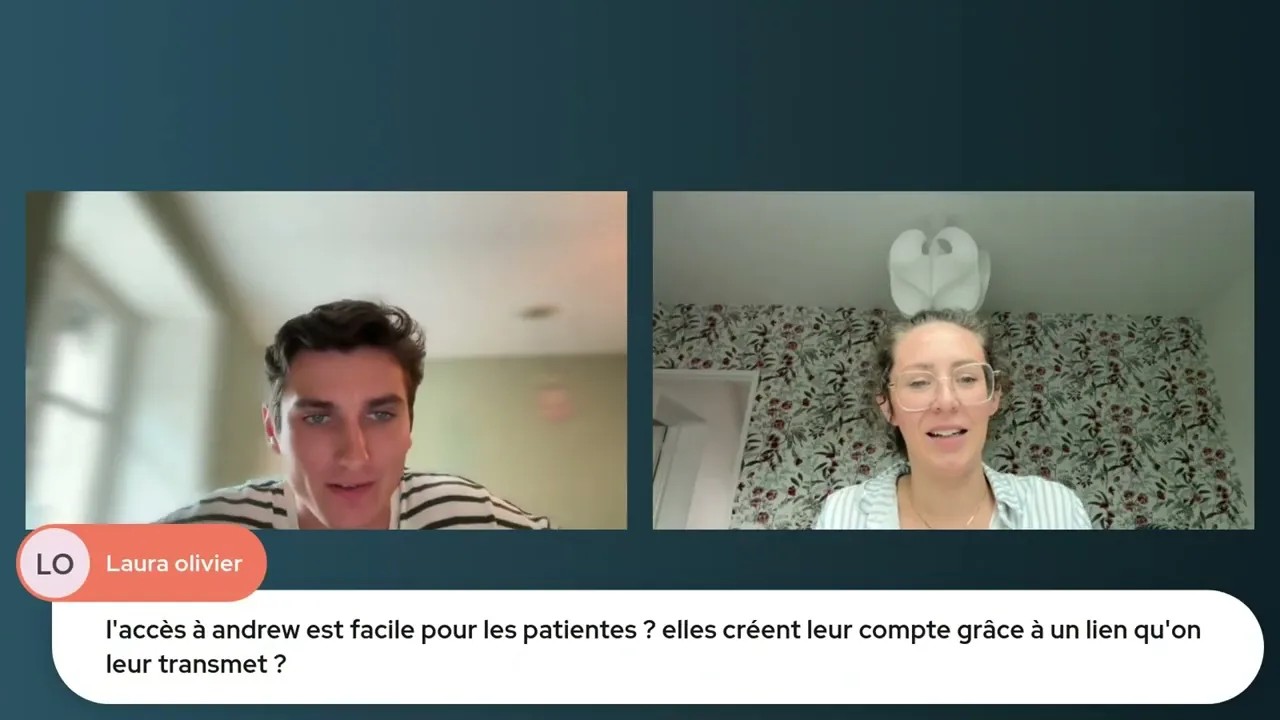
During the webinar “How to improve our postpartum care” with Julie Cantournet, a very practical question was asked:
👉 “Is access to Andrew® easy for patients? Do they need to create an account via a link?”
The answer is simple and reassuring: Andrew® was designed to be fast, intuitive, and hassle-free, even for patients who are not used to digital tools. To support this point, you can also read our analysis on adherence to Andrew® among seniors; proof of its ease of use.
Easy access without creating an account on the patient side
The process is intended to be minimal:
The practitioner simply adds the patient's email address on the platform. They can later add various civil-status details to complete the profile and record (last name, first name, phone number, date of birth, postal code).
The patient then receives their login and password (temporary) to access their personal space. They will later be asked to change it to ensure the security of their exercise app.
No other setup or account creation is necessary, which reduces friction and makes onboarding easier. And if the therapist encounters issues during setup or use, they can always refer to the therapist who handles support and responds in less than 2 minutes.
Tools to go even faster
Some practices use QR codes or printable visuals in the clinic:
The patient scans the QR code, and the physio app is directly downloadable or accessible with no intermediate step. This allows an immediate start, ideal for patients in a hurry or with young children.
The physiotherapist can also directly print visuals or posters in the clinic to inform patients about what Andrew® is and how it is used by the patient.
If you would like us to send you these visuals to highlight the use of our physiotherapy software for prescribing exercises, please do not hesitate to contact us directly.
Why is simple access crucial in postpartum care?
Postpartum patients often have little free time, juggling baby care, medical follow-up, and personal life. It is therefore crucial that physiotherapy follow-up fits reasonably into all of that.
Quick access allows programs to start immediately, without wasting time. This is also true outside postpartum follow-up; any physiotherapy app needs to be smooth and fast.
It facilitates adherence to conventional exercise programs and to non-billing-code programs via Andrew® and continuity of exercises. All with the goal of making the patient increasingly autonomous.
Integration with follow-up and exercises
The patient can access all prescribed exercises as soon as the account is activated. They can also do them in one or multiple sessions and always keep their physiotherapist informed of their progress, whether they have pain or issues.
The exercises are organized by level and goal, allowing structured and progressive follow-up. The content is prescribed by the physiotherapist in a way adapted to the patients' needs and allows management of as many characteristics as desired (repetitions, hold time, to failure, tempo, irritability, load, intensity, RPE…)
The practitioner can update or adjust programs remotely, which strengthens personalized follow-up. The exercises will be synchronized directly on the patient's physiotherapy app.
💡 110: Average number of times a patient opens their Andrew® exercise prescription app.
In summary
Quick and easy access for all patients
No complex account creation, just a login and password
QR code available for an even easier start
Ideal for maximizing adherence and postpartum follow-up
Any other questions? Check our other articles or get in direct contact with an Andrew® therapist.
After presenting the simplicity of access to Andrew® for patients, it is equally important to focus on optimizing remote follow-up through physiotherapy teleconsultation for postpartum care.
If quick access makes it easier to start programs and adhere to exercises, teleconsultation makes it possible to maintain continuity of sessions, support patients despite unforeseen events, and effectively integrate Andrew® exercises into their care pathway, while ensuring structured and progressive follow-up.
During the webinar, a practical question was asked about physiotherapy teleconsultation:
👉 “What is the purpose of teleconsultation in postpartum care and how should it be integrated into patient follow-up?”
Julie Cantournet emphasizes: teleconsultation (TC) represents a major added value, especially in the postpartum context where unforeseen events are frequent.
Never lose a session despite unforeseen events
Postpartum follow-ups are often affected by:
Baby is sick or unavailable for various reasons.
Appointment canceled at the last minute and sometimes without warning the therapist.
Relatives unable to babysit, which would force the mother to bring the child to the appointment: difficult to do.
Thanks to physiotherapy teleconsultation, the session is never lost. Julie explains:
“Even if something comes up, we can do the teleconsultation, review therapeutic education, correct posture, and prescribe exercises via Andrew®. The session remains productive and billable.”
💡 Since 2025, physiotherapists can benefit from a new FAMI aid, an optional indicator, allowing them to obtain €350 in subsidies. Find our article on this topic here.
It is important to remember that in physiotherapy teleconsultation, all acts covered by the NGAP can be performed (and therefore reimbursed for the patient) except:
the first assessment session (if performed via telecare, this would be a non-billed act)
acts requiring direct contact with the patient, in person (example: urgent airway clearance in the case of respiratory rehabilitation is excluded; the same applies to 1 acute flare-up during a chronic respiratory condition) ;
acts requiring specific equipment that the patient does not have (example: hydrotherapy setup).
Greater patient satisfaction
Physiotherapy teleconsultation allows:
Continuity of follow-up, despite family or logistical constraints, and therefore the possibility of prescribing exercises that patients can follow.
Complete postural and educational support, remotely. This helps lighten the new mother's schedule and potentially assist her in rehabilitation.
Exercise prescription directly via the Andrew® physiotherapy app, for structured and progressive follow-up.
💡 More than 1,500 teleconsultations have been carried out with Andrew®.
Financial aid to facilitate access
The government offers a €350 subsidy for physiotherapy teleconsultation, useful for postpartum follow-ups. This aid is part of the Practice Modernization and Computerization Support Package (FAMI) of the practice and is independent of the indicator related to teletransmission aid.
The out-of-pocket cost for therapists is therefore very low. This makes it possible to have an essential tool for physiotherapy practice and make patients autonomous in a low-cost and simplified way.
This makes teleconsultation accessible and attractive, even for reluctant therapists. As a reminder, the challenge of promoting telecare in physiotherapy is a public health issue. Prioritize follow-ups that can be done in a hybrid way to free up assessment slots and thus unclog waiting rooms and limit loss of chance for these patients.
💡 Definition: Teleconsultation is a remote consultation between a healthcare professional and their patient using information and communication technologies.
4. Integration into the care pathway
Physiotherapy teleconsultation sessions can be combined with Andrew® to send personalized programs and exercises. It is ideal to combine the main need (exercise prescription) with the need to see patients via telecare.
Allows monitoring the patient's progress, even remotely, and therefore no longer letting patients drift without being able to know their progress.
Promotes active and autonomous engagement of the patient in their postpartum follow-up and thus limits the risk of complications or prolongation of rehabilitation.
In summary
Postpartum teleconsultation makes it possible to manage unforeseen events and never lose a session
It ensures continuity of follow-up and delivery of exercises via Andrew®
State aid makes this service very affordable for physiotherapists
A practical and effective solution to maximize adherence and progress
Article Sources